
Video Art Nights 2026/27
Video Art Nights 26/27
Nightly from 6 pm until March 2027
In the Kunsthalle’s display window
Flo Kasearu
(De)fence, 2014
Video (HD), 5 min 44 sec
George Landow
The Evil Faerie, 1966
16 mm film, 28 sec
This autumn and winter, a historical work by George Landow (1944–2011) enters into dialogue with a work by Flo Kasearu (*b. 1985) from the collection of Kunsthalle Recklinghausen. Regular visitors may already have seen the Estonian artist Kasearu’s video work twice: first, projected on a large scale on the top floor during her Ruhrfestspiele exhibition in 2022, and then, last year, in a more intimate setting on the ground floor as part of the collection presentation Affinities. Now her work (De)fence (2014) is on view in the building’s façade window, perhaps finding a setting that is particularly well suited to its original filming location. The work explores the idea of enclosing and protecting spaces, particularly at the boundary between the private and the public—and in relation to the museum context.
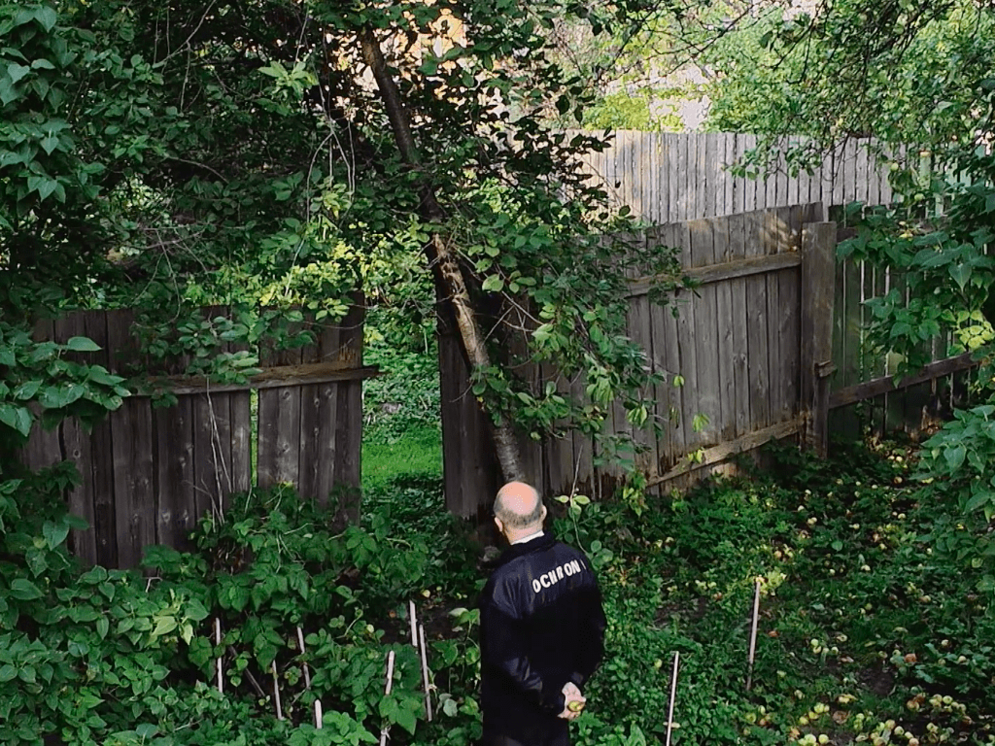
Flo Kasearu had asked the National Gallery in Warsaw to provide security for her own Flo Kasearu House Museum - the house in Tallinn where she lives - during her absence. A hole in the fence surrounding her garden was subsequently guarded by an employee of the security company who normally looks after the artworks in Warsaw. While Kasearu was away, he therefore took on the task of guarding this hole at the Polish National Gallery. He became the subject of her video work, which documents him pacing back and forth, helping himself to apples falling from the trees in autumn and, somewhat ironically, protecting an empty space.
Kasearu’s work has often been interpreted in relation to the so-called Iron Curtain or the permeability of the art system. As part of the Kunsthalle’s collection, the first of three video works to have entered the collection since 2022, the piece takes on an intriguing site-specific dimension. Now, during the hours of darkness, a museum guard can be seen pacing back and forth on screen, as though he were also protecting our building behind the windows. In keeping with the season, the ginkgo trees outside the Kunsthalle are at precisely the same stage of the year as the trees in Kasearu’s video, at least at the beginning of the presentation period in late November.
Presented as a rear projection in a window, the work also gives rise to a noteworthy media-historical constellation. Looking into a house from the street offers a view out into a garden. The architectural opening onto the interior reveals another exterior, thus echoing a classical Western conception of painting as a “window onto the world”, an idea that persisted well into the twentieth century. Since the nineteenth century, the window has also increasingly featured as a motif in depictions of nature.
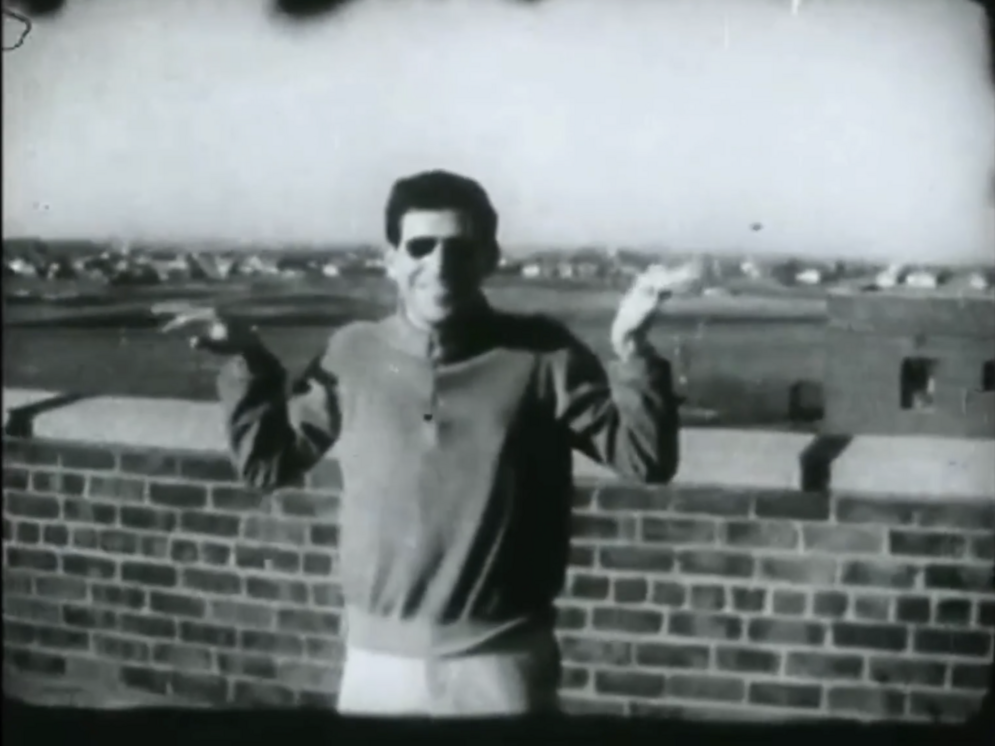
The film that follows, lasting a mere 28 seconds, once again comes from the Flux Film Anthology, the compendium of films made between 1962 and 1970 assembled by George Maciunas. In his film The Evil Faerie, the experimental filmmaker George Landow, who also went by the name Owen Land, features the now largely forgotten actor Steven M. Zinc. Wearing sunglasses, he stands on a rooftop and grins while making movements reminiscent of flapping wings or the fluttering of a hummingbird - or, indeed, a fairy. Only right at the end does the image of a so-called “China Girl” briefly appear. From today’s perspective, this is a contested term referring to a particular feature of the history of motion-picture film. The American filmmaker Landow was well acquainted with these “hidden” images and would later recreate them as a subject in his ten-minute colour film of 1976. “China Girls”, “Kodak LAD Girls” or “leader ladies” were colour test images inserted at the beginning or end of a film to allow projectionists to make colour corrections before the film began. Often, these images featured porcelain doll faces, china being an outdated English term for porcelain, but actual portrait photographs were also used, frequently depicting women. Often dressed in brightly coloured silk costumes and accompanied by a colour scale, these images served as invisible calibration tools. They were always present on the film stock, yet were never seen by the audience.
The “evil fairy”, as the title of the 28-second film has it, thus refers both to the protagonist, who spends the first 15 seconds imitating a hovering fairy, and to his sunglasses and forced smile, which hardly correspond to our image of a benevolent fairy. The word evil seems to refer primarily to him. The hidden fairy who appears at the end, operating behind the scenes and making many things possible without our knowledge, is the actual fairy and the less evil one. Taken together, however, the two works are particularly compelling in their engagement with the figure of absence. Kasearu’s video revolves around the artist’s absence and the absence of a section of fencing, a gap that prompts the protagonist, in this case the museum guard, to spend time in the garden outside the house. Landow’s flying male fairy on the rooftop, meanwhile, is essentially just a prelude to the hidden female figure residing unnoticed in the test strip. The work therefore also raises questions about the visibility of non-male figures in the art world and in society at large. In other words, both Flo Kasearu’s and Landow’s works bring to light spaces and possibilities of access that are not always visible, as well as the people whose efforts make so much possible in the first place. Landow sometimes takes paths associated with Jewish mysticism in the form of Kabbalah, whereas Kasearu devises an entirely personal kingdom of her own as an artist, in a world that could certainly use a few more queens rather than yet another king.
The Kunsthalle’s windows have long been a highly visible feature of the building and have repeatedly been incorporated into individual exhibition projects. When Dr Nico Anklam took over as director of the museum in summer 2021, the windows regained their original appearance with their reopening, and this part of the building was also reimagined for the winter months. Every night from 6 pm onwards, video art is shown as a rear projection in the southernmost window. Free of charge and accessible to everyone, throughout the night.
Informationen
| Regular | 5 € |
| Reduced* | 2,50 € |
| Children under 14 | free |
| Saturday | Pay-what-you-want |
| Kunsthalle Recklinghausen |
| Große-Perdekamp-Straße 25–27 |
| 45657 Recklinghausen |
| Tel: +49(0)2361-50-1935 |
| Fax: +49(0)2361-50-1932 |
| Mail: info@kunst-re.de |