Im Kabinett: Ayaka Terajima
18 July – 16 August 2026
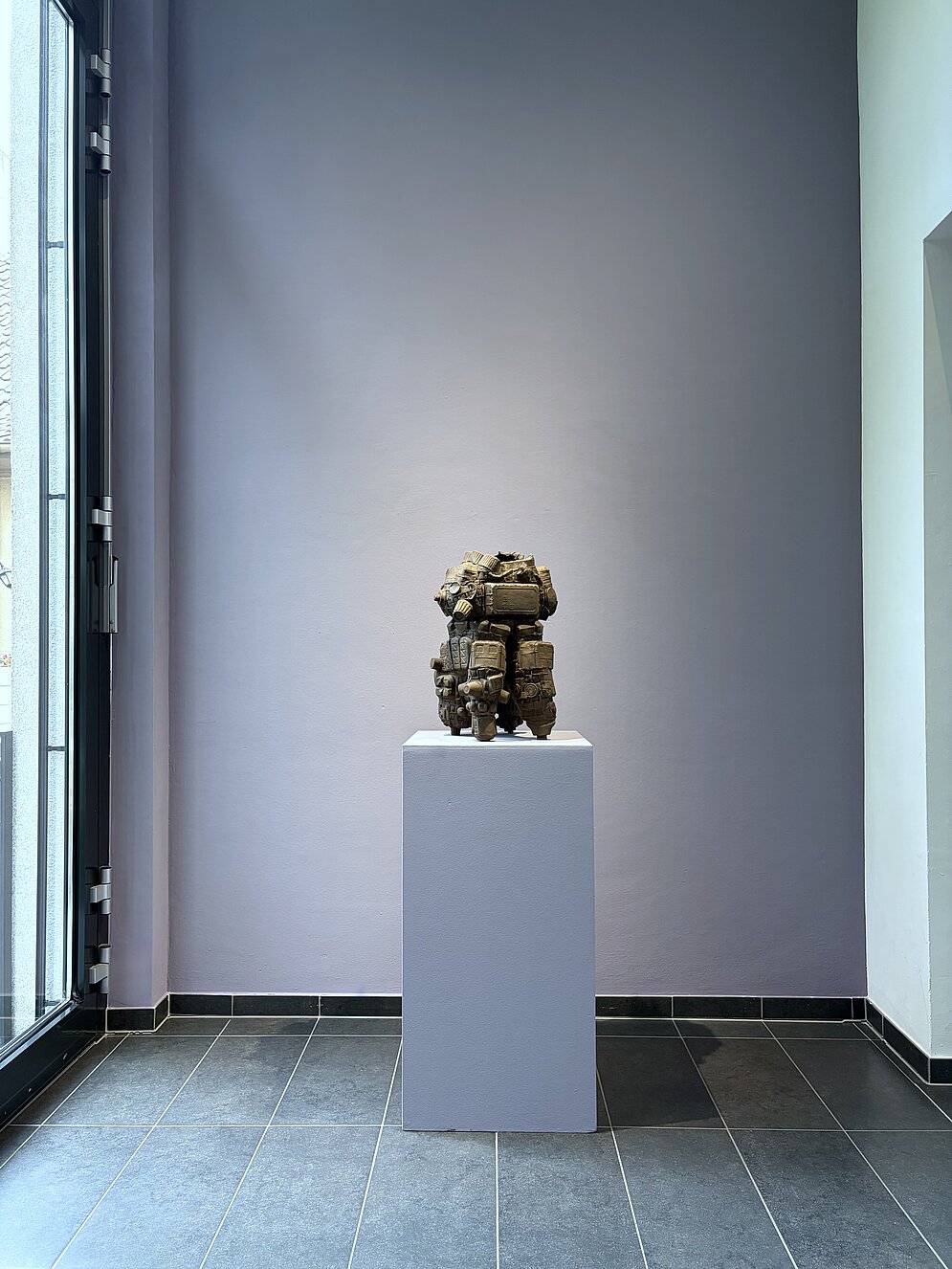
Ayaka Terajima’s sculptures remarkably combine two strands of the history of sculpture: the Japanese Jōmon period, from approximately 14,000 to 1,000 BCE, on the one hand, and the question of how to represent negative spaces, on the other.
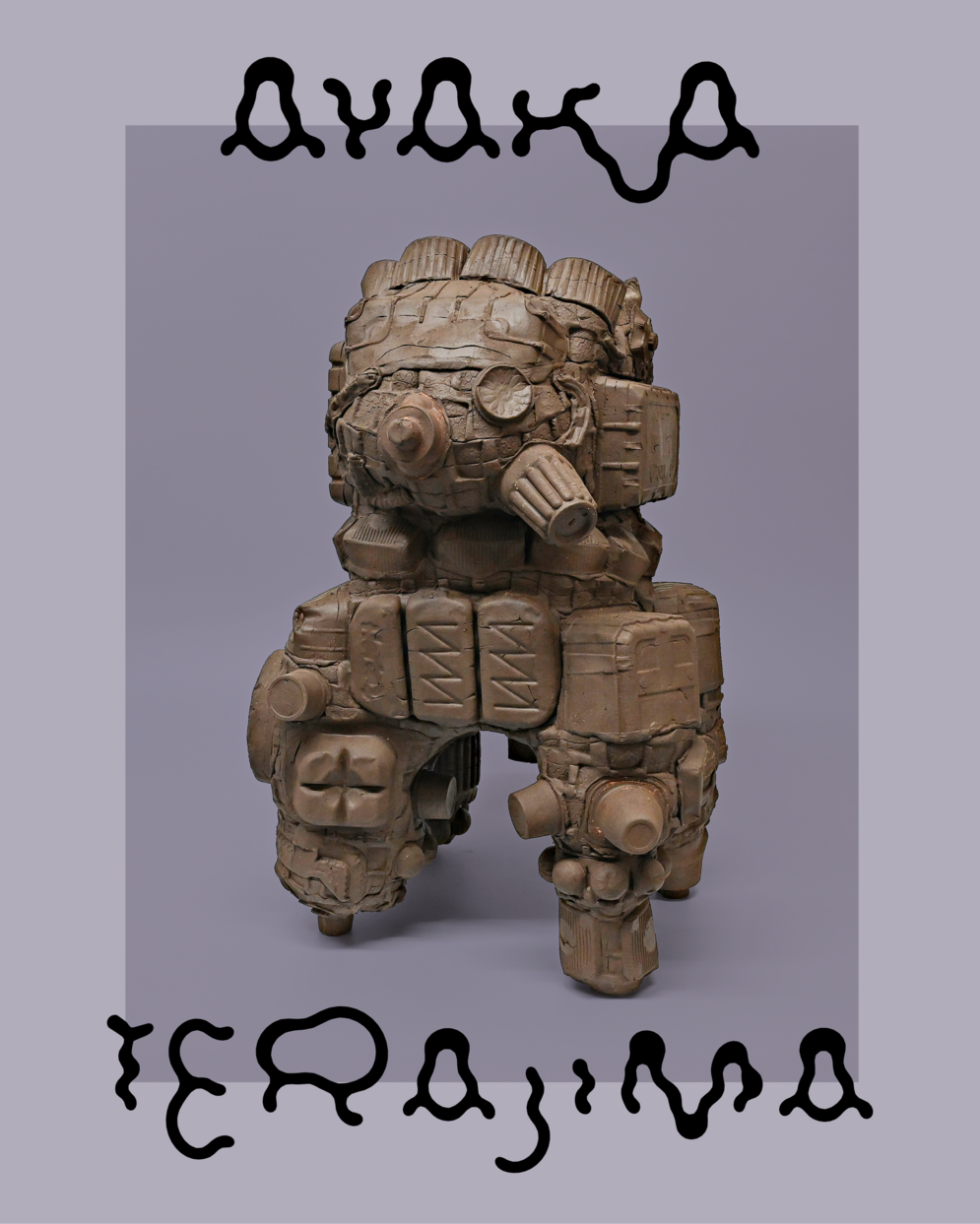
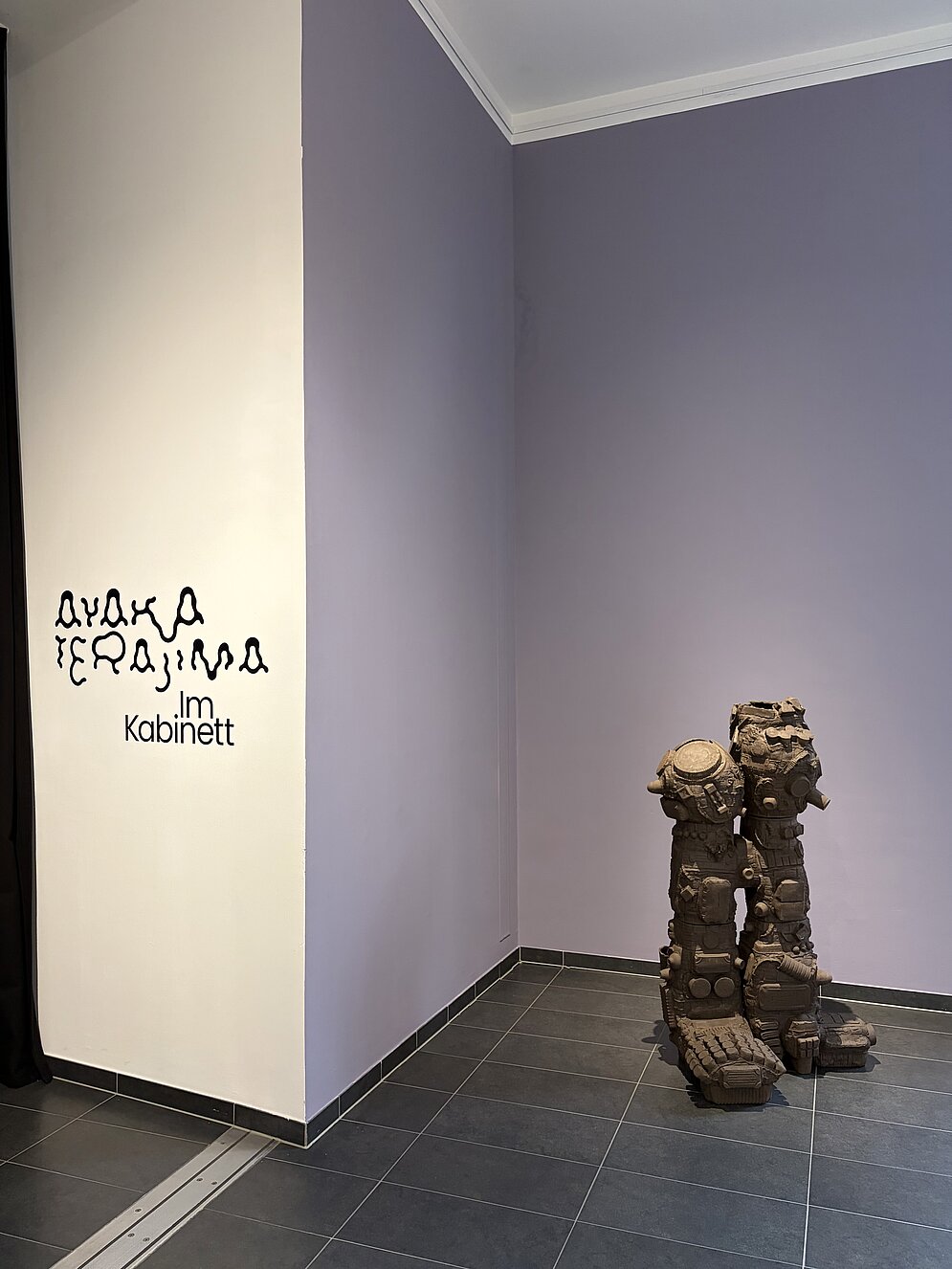
At first glance, however, her clay works appear to be endearing creatures that seem to have made their way from science fiction films or fairy tale books into the Kunsthalle “Three-headed Doki,” for example, initially brings to mind the earthy yet robotic limbs of a mythical creature, and “Middle Four Legs,” with its rounded overall form, seems to be related to a mixture of the Ewoks from Star Wars and Luke Skywalker’s little companion, R2-D2.
Yet Ayaka Terajima’s objects are, in their form, quite classical sculptures; interestingly, their surface texture does not arise directly from shaping by the human hand, but rather from the imprints of packaging materials applied by it. That is, they derive precisely from industrial plastics—in the sculptural sense—which used to be made of plastic—in the material sense—and today are often made of recycled materials, whose primary purpose is to organize, protect, compartmentalize, or make other objects suitable for shipping. Think of all the trays, plastic containers, or egg cartons you’ve ever held in your hands. As unworthy of being called sculptures as they may seem to us in everyday life, they are now central to the surface structure of Terajima’s objects. It is thus the inner negative spaces inherent in these otherwise seemingly unimportant containers that now give form to these friendly protagonists from Terajima’s universe.
Terajima herself makes it clear that these strategies are not limited to the famous works of the British sculptor Rachel Whiteread from the 1990s, but date back much further, noting that the ancient amphorae and vessels of Japan’s Jōmon period made use of very similar techniques. The potters of that era also pressed ropes, shells, or plants into the still-wet clay to shape the surfaces of their objects. Terajima, on the other hand, does not present the form to us as decoration in the imprint; rather, it looms toward us, settling upon the bodies of her objects like a shifting industrial landscape. They almost resemble a cityscape, with towers, houses, and chimneys that make up the skin of a cosmic giant, now standing quite small and tamed in the Kunsthalle.
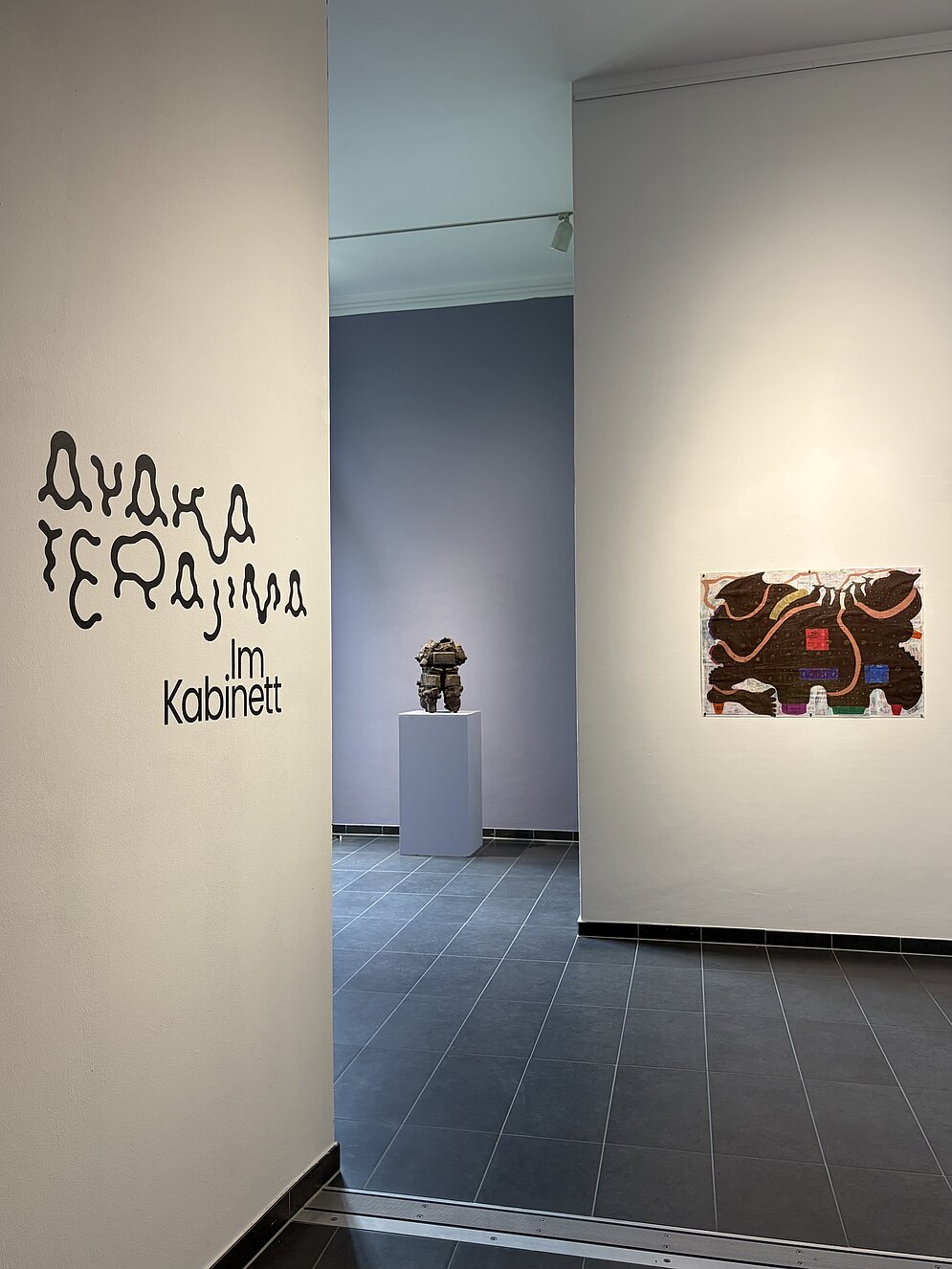
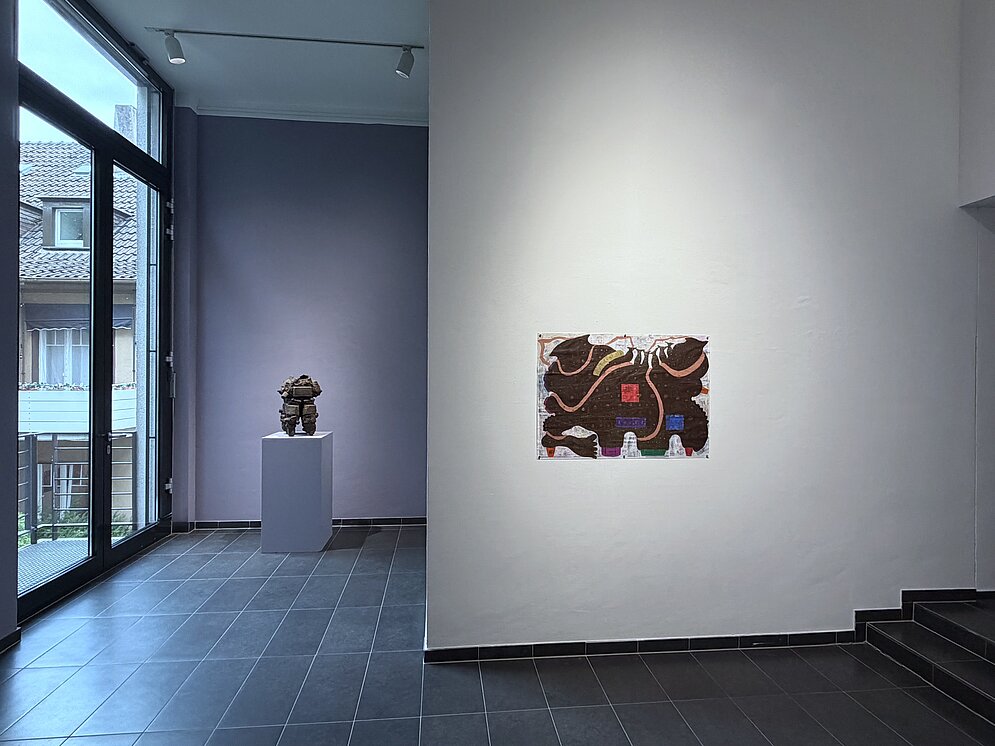
If we now also consider her works on paper, the impression is confirmed that we are facing entirely friendly beings which, when captured as drawings, could be vedute, landscapes, or maps—and which, through their scratches, overpaintings, and fine-lined surface structures, demonstrate just as successfully in two dimensions what their three-dimensional counterparts attempt: to break open the surface and the content beneath it and partially swap them.
I can easily imagine navigating Terajima’s universe using her maps on paper, encountering now and then one of her multi-headed beings, who silently but benevolently point the way to their next relative somewhere in space between the Jōmon period and an art museum in the Ruhr region.
Japanese artist Ayaka Terajima (*1987) first studied ceramics at the Tokyo University of the Arts. In 2023, she graduated in Sculpture and Fine Arts from the Academy of Fine Arts Munich (AdBK), where she studied in the class of Nicole Wermers. In 2024, she received the Bavarian Art Prize for the Promotion of the Arts.
With the exhibition format "Im Kabinett", the Kunsthalle Recklinghausen has begun a new series in 2022, bringing young artists to Recklinghausen in the summer, shortly after graduating from art school. Located in a transitional space of the museum, “Im Kabinett” shows, through two sculptures and a drawing by Ayaka Terajima, that a carefully curated selection of works can achieve a striking effect.
Exhibition opening on Friday, 17 July, at 6 pm.
Informationen
| Regular | 5 € |
| Reduced* | 2,50 € |
| Children under 14 | free |
| Saturday | Pay-what-you-want |
| Kunsthalle Recklinghausen |
| Große-Perdekamp-Straße 25–27 |
| 45657 Recklinghausen |
| Tel: +49(0)2361-50-1935 |
| Fax: +49(0)2361-50-1932 |
| Mail: info@kunst-re.de |